

1. Introduction
In modern water conservancy, hydropower, municipal water supply, and large-scale industrial systems, flow control equipment plays a decisive role in system safety and operational stability. Among various valve types installed in large-diameter pipelines—such as ball valves, sleeve valves, and butterfly valves—large butterfly valves are widely adopted due to their compact structure, reliable sealing performance, and cost-effective manufacturing characteristics.
Especially in hydropower stations and long-distance water transmission systems, large butterfly valves are commonly installed at turbine inlet pipelines or main control sections. Their primary task is not frequent regulation, but reliable isolation and emergency shut-off under both static and dynamic water conditions. Compared with other valve types, butterfly valves have fewer components, lower weight for the same diameter, and relatively simple operating mechanisms, making them suitable for large-diameter applications.
However, it should also be noted that when fully open, a butterfly valve disc remains in the flow path and inevitably causes some disturbance to the fluid. This characteristic places higher demands on hydraulic design, structural strength, and manufacturing accuracy, especially for large butterfly valves operating under high pressure and large flow rates.
This article focuses on large butterfly valves used in water and energy systems. Based on practical manufacturing experience, it introduces their structural features, functional roles, manufacturing principles, valve body machining processes, key tooling and equipment, as well as assembly and testing procedures. The goal is to provide a clear and accessible overview for engineers, project managers, and buyers who want to better understand how large butterfly valves are designed and manufactured.
2. Structural Features of Large Butterfly Valves
2.1 Basic Structural Configuration
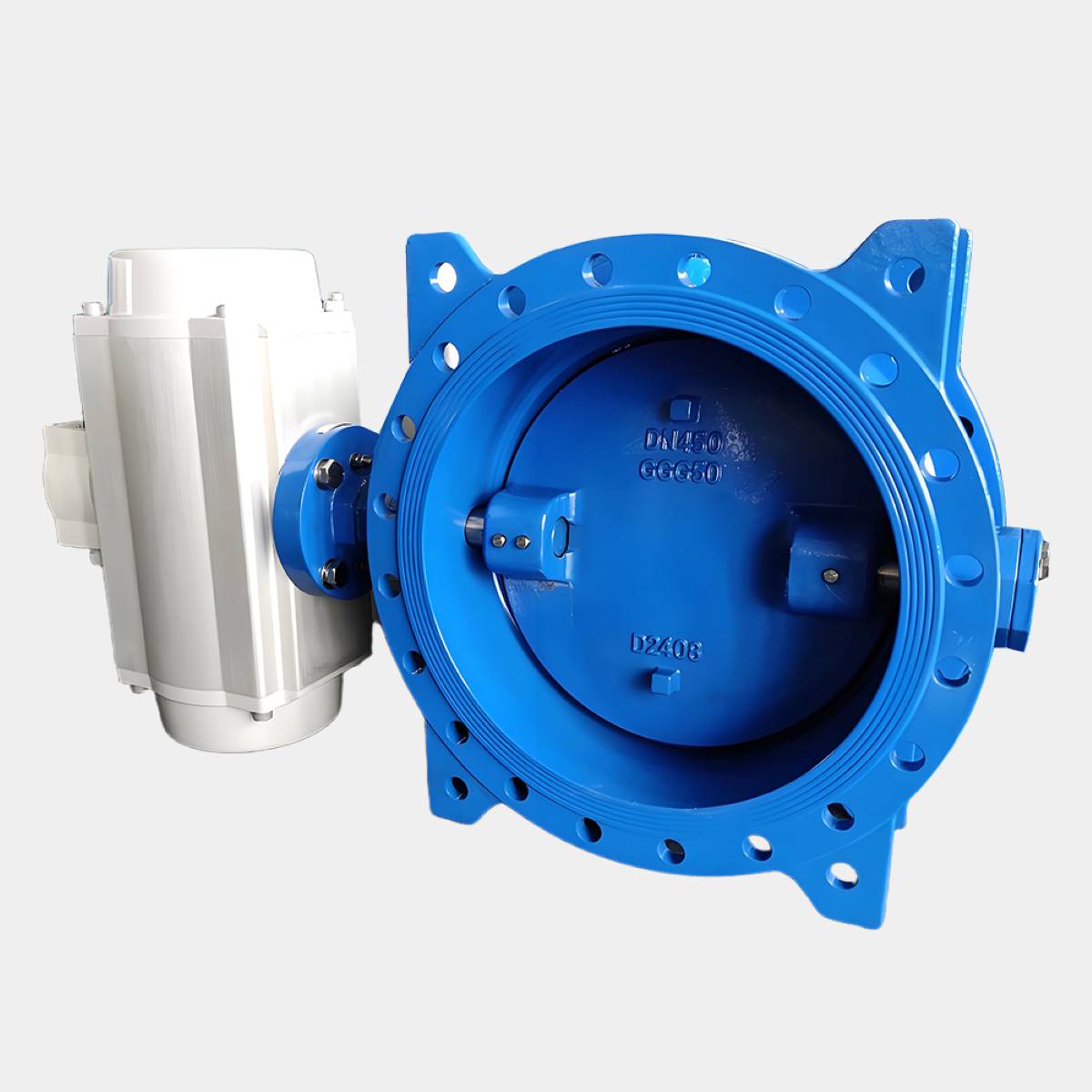
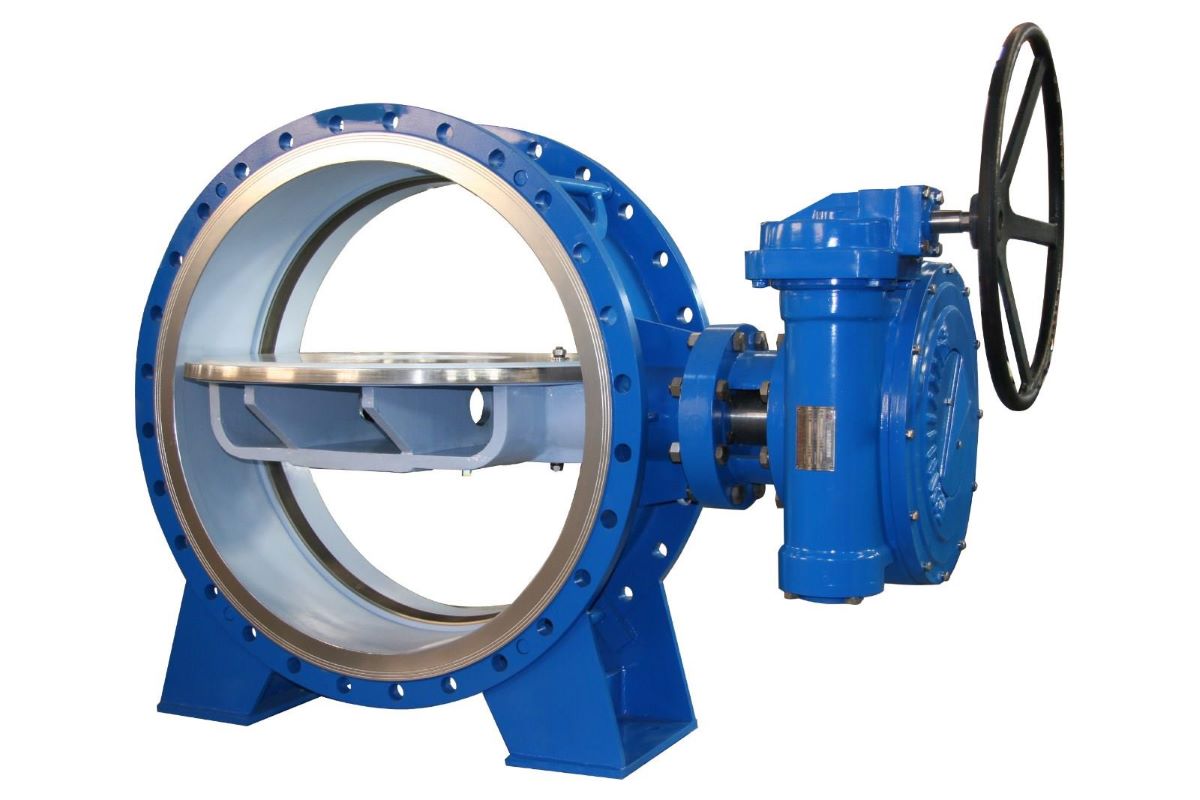
The most typical structure of a large butterfly valve used in water and hydropower projects is the double-eccentric, hydraulically controlled butterfly valve with counterweight closing. This design combines reliable sealing, smooth operation, and inherent safety features, making it suitable for critical installations.
In general, a large butterfly valve consists of the following main components:
- Valve body
- Valve disc (also called the closure element or leaf)
- Valve shaft
- Sealing system
- Hydraulic actuator (servomotor)
- Locking and positioning devices
- Connecting pipes and expansion joints
- Bypass pipeline system
- Automation and monitoring devices
Each of these components plays a specific role, and their coordination determines the overall performance of the valve.
The operating mechanism is typically a straight-cylinder swing-type hydraulic servomotor. Under normal conditions, the valve is opened by hydraulic pressure and closed by the gravity of a counterweight. This “oil-pressure opening, counterweight closing” principle ensures that the valve can still close safely in emergency situations such as power failure or hydraulic system malfunction.
2.2 Valve Body Structure
The valve body of a large butterfly valve is usually fabricated using a welded steel plate structure rather than casting. This approach offers better control over material quality, reduces internal defects, and is more suitable for large diameters.
The valve body typically includes:
- An upstream flange for connection to the inlet pipe
- A downstream flange connected to an expansion joint
- Supporting feet or base plates
- Two valve seats for supporting the valve disc
- Hydraulic locking devices for fully open and fully closed positions
- Limit switches to indicate locking status
From a structural standpoint, the valve body must have sufficient strength and stiffness to withstand internal pressure, external loads, vibration, and dynamic water forces. During operation, all vertical loads and dynamic forces are transmitted to the foundation through the support base. Therefore, the base design is critical for long-term stability.
To facilitate installation and maintenance, anchor bolt holes in the base are often designed as elongated slots. This allows slight axial movement of the valve body to accommodate installation tolerances and thermal expansion. The contact surfaces are carefully machined and coated with lubricant to allow controlled movement without damaging the foundation.
2.3 Valve Disc Design and Double-Eccentric Structure
The valve disc is the core moving component of a butterfly valve. For large butterfly valves, the disc usually adopts a double-plate hollow frame welded structure, which effectively reduces weight while maintaining sufficient strength and stiffness.
One of the most important design features is the double-eccentric configuration, which includes:
- Eccentricity between the disc center and the valve body center
- Eccentricity between the valve shaft and the disc center
This double eccentricity significantly reduces friction between the sealing surfaces during opening and closing. More importantly, it provides a hydraulic self-closing characteristic, allowing the valve to close automatically under flowing water in emergency conditions. This feature is particularly valuable for turbine protection in hydropower stations.
To improve hydraulic performance, the ribs and cover plates of the disc are often designed with airfoil-shaped profiles on both upstream and downstream sides. This streamlined design minimizes flow disturbance, prevents vibration in high-velocity flow, and reduces flow resistance when the valve is fully open.
2.4 Bypass System and Pressure Equalization
Large butterfly valves are typically designed for static water opening. This means that before the main valve is opened, the pressure difference between the upstream and downstream sides must be reduced to an acceptable level.
To achieve this, a bypass pipeline is installed around the main valve. The bypass valve is usually a hydraulically operated needle valve. Before opening the butterfly valve, the bypass valve opens automatically to allow water to flow slowly and equalize pressure.
Pressure equalization is monitored using pressure transmitters or differential pressure transmitters. Only when the measured pressure difference meets the specified requirement will the control system allow the butterfly valve to open. The opening and closing time of the bypass valve is typically adjustable between 0 and 20 seconds to prevent excessive water hammer.
3. Functions of Butterfly Valves and Manufacturing Principles
3.1 Main Functions of Large Butterfly Valves
From an application perspective, large butterfly valves mainly serve the following functions:
Emergency shut-off under dynamic water conditions
In the event of a unit failure or pipeline accident, the valve must close quickly to prevent the situation from worsening.
Isolation during turbine or system maintenance
When maintenance is required, the butterfly valve provides a reliable water barrier, allowing safe inspection and repair work downstream.
Long-term isolation during shutdown
For units that remain out of service for extended periods, closing the butterfly valve prevents upstream water from causing erosion, wear, or unwanted rotation of turbine components.
Because sealing reliability is the most critical function, large butterfly valves are primarily designed as shut-off valves rather than regulating valves.
3.2 Core Manufacturing Principles
Based on their function, the key manufacturing principles of large butterfly valves can be summarized as follows:
- Reliable sealing performance
- Accurate and flexible movement
- Stable and durable structure
Sealing reliability depends on multiple sealing interfaces, including:
- Main seal between the valve body and disc
- Composite sealing at the valve shaft
- Seals at component joints
To achieve reliable sealing, strict control over dimensions, surface roughness, and geometric tolerances is required. Even minor deviations can lead to leakage under high pressure.
Accurate and flexible operation requires not only precise manufacturing of the actuator components, but also strict control of coaxiality between the valve body, disc shaft holes, and sealing surfaces. This is one of the most challenging aspects of large butterfly valve manufacturing.
4. Valve Body Machining Process and Key Equipment
4.1 Main Machining Processes
The valve body of a large butterfly valve undergoes multiple machining stages, from rough machining to high-precision finishing. The primary machining equipment includes:
- Vertical lathes
- Boring machines
For rough turning and rough boring, conventional vertical lathes and boring machines are sufficient. However, for finishing operations, CNC vertical lathes and CNC boring machines with rotary tables are required to ensure dimensional accuracy and consistency.
The valve body sealing surface has very high surface roughness requirements. In many cases, turning alone cannot meet the design specification. Therefore, after precision turning, grinding heads are used to perform fine grinding on the sealing surface. This step is essential for achieving the required sealing performance.
4.2 Tooling and Auxiliary Equipment
In addition to machine tools, various specialized fixtures and tools are required during machining, assembly, and testing, including:
- Sealing surface inspection templates
- Valve body hydrostatic test tools
- Butterfly valve sealing and operation test fixtures
These tools ensure accurate measurement, safe testing, and repeatable results throughout the manufacturing process.
5. Assembly and Testing of Large Butterfly Valves
5.1 Overview of Assembly and Testing
Assembly and testing are critical stages that directly determine whether a large butterfly valve meets design and safety requirements. Most tests are carried out in the manufacturing facility before delivery.
The main tests include:
- Valve body hydrostatic pressure test
- Sealing performance test
- Valve disc operation test
Each test must strictly follow the specified procedures and acceptance criteria.
5.2 Main Assembly and Testing Steps
The complete assembly and testing process of a large butterfly valve typically includes more than 20 detailed steps. Key stages include sealing installation, pressure testing, precision boring, final assembly, and operational testing.
First, sealing rubber strips are installed in the valve body sealing grooves and securely bonded at joint areas. The valve body is then assembled with the hydrostatic test cover and placed on support blocks on the assembly platform.
After filling the valve body with water, pressure is increased in stages according to design requirements. Each pressure stage is held and inspected to ensure there is no leakage. The pressure holding time is usually 30 minutes.
Once the valve body passes the hydrostatic test, the valve disc is assembled. Precision boring is performed on the disc shaft holes to ensure perfect alignment with the valve body. Steel sleeves, bearings, and shaft seals are then installed.
The main sealing ring and sealing pressure plates are installed, followed by preliminary opening and closing tests of the disc. After this, sealing performance tests are conducted under pressure, again with a holding time of 30 minutes and strict leakage limits.
Subsequently, the operating arm, locking device, counterweight, and automation components are installed. Self-closing tests using the counterweight are performed to confirm that the valve can close reliably under gravity.
Finally, after all operational tests are completed successfully, the valve is disassembled for cleaning, surface protection is applied, and the valve is painted according to specification.
6. Conclusion
Large butterfly valves are not simply scaled-up versions of small valves. Their design and manufacturing involve complex structural considerations, precise machining, and rigorous testing procedures. From the welded steel valve body and double-eccentric disc design to high-precision sealing surfaces and comprehensive factory testing, every step is closely related to safety and long-term reliability.
For users and buyers, understanding the structural features and manufacturing process of large butterfly valves helps in selecting the right product, evaluating supplier capabilities, and ensuring smooth project execution. For manufacturers, strict adherence to manufacturing principles and quality control standards is the foundation for delivering dependable valves to global markets.
As infrastructure projects continue to grow in scale and complexity, large butterfly valves will remain an essential component in water and energy systems, playing a critical role in safe, efficient, and sustainable operation.
Post time: Dec-30-2025