

Introduction
If you’ve ever looked at a Y strainer and a T strainer side by side, you might have wondered: they both filter out dirt and debris from pipelines, so why do they look so different? And more importantly, why do some systems use one while others swear by the other?
Here’s the thing: they serve the same basic purpose, but they’re built for completely different conditions. Pick the wrong one, and you’ll either be cleaning it constantly, dealing with excessive pressure drop, or watching it fail to protect your expensive downstream equipment. Get it right, and your pumps, valves, and meters will run smoothly for years with minimal maintenance.
One is like a compact guard that fits almost anywhere – great for small spaces and clean fluids. The other is a heavy-duty workhorse with a big appetite for debris – perfect for large pipelines and dirty systems. Understanding the difference isn’t just technical trivia; it’s the key to keeping your entire system running reliably.
In this guide, we’ll break down exactly how each strainer works, compare them across the factors that actually matter, and give you a clear rule for choosing the right one. No fluff. Just practical advice you can use.
What Is a Y Strainer?
Let’s start with the Y strainer, because it’s the one you’ll see most often in the field.
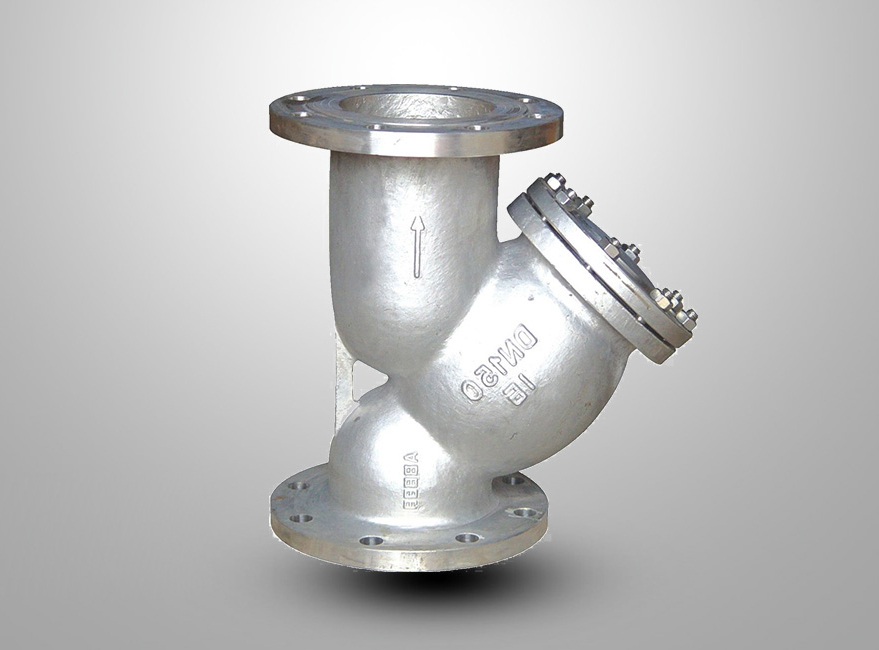
As the name suggests, a Y strainer is shaped like the letter “Y”. Inside the body, there’s a filter element – usually a perforated or wire mesh screen – mounted at an angle in the branch leg. Fluid enters through the inlet, passes through the screen, and exits through the outlet. The debris gets trapped on the screen, while the clean fluid continues downstream. The dirt settles into the angled pocket at the bottom, which is designed to collect and hold contaminants .
Why the angled design? It’s all about saving space. The Y shape allows the strainer to fit into tight piping layouts where a bulkier design simply wouldn’t work. You can install a Y strainer in both horizontal and vertical pipelines, which gives you a lot of flexibility . The blow-down connection at the bottom also makes cleaning relatively simple – you can open the cap and flush out the accumulated debris without removing the entire strainer from the line.
Key characteristics of Y strainers:
- Compact design – Fits into tight spaces where larger strainers won’t go
- Versatile installation – Works in both horizontal and vertical pipelines
- Moderate dirt-holding capacity – The angled pocket can hold a reasonable amount of debris, but not a huge volume
- Cost-effective – Generally less expensive than T strainers of the same size
- Ideal for clean fluids – Performs best when the media is relatively clean, like water, steam, or gas
Y strainers are particularly popular in steam systems. In fact, many engineers consider them the standard choice for steam applications – they handle high temperatures and pressures well, and the angled pocket naturally collects condensate, which can be drained through a steam trap at the blow-down connection .
Common Y strainer applications:
- Upstream of control valves and pressure reducing valves
- Inlet to pumps and compressors
- Steam trap inlet lines
- HVAC systems and water treatment
- Natural gas and compressed air lines
- Protecting flow meters and other precision instruments
What Is a T Strainer?
Now let’s look at the T strainer – and you’ll immediately see it’s a very different beast.
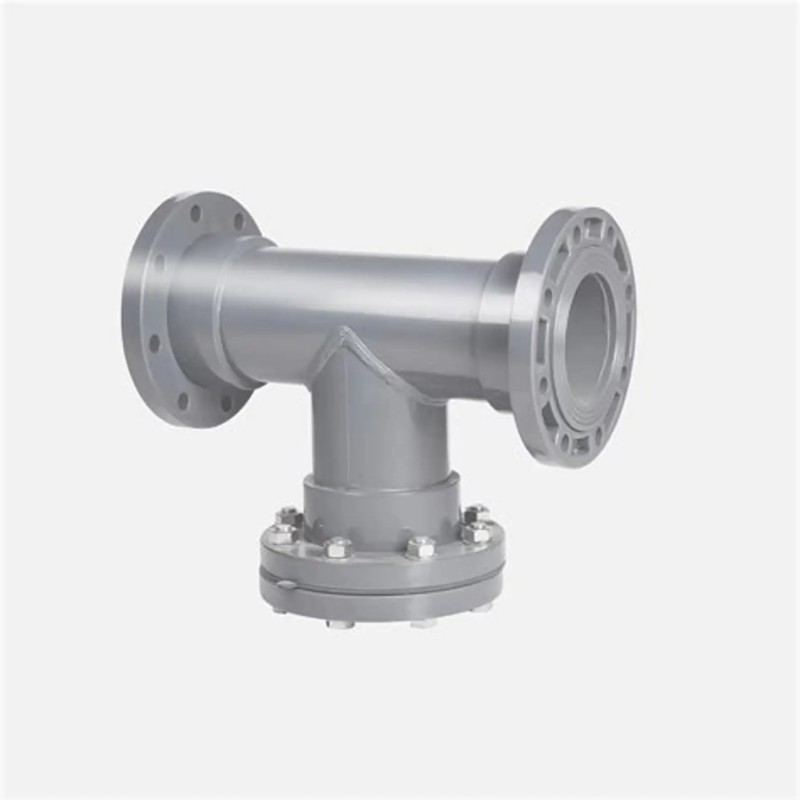
A T strainer is shaped like a “T”. The inlet and outlet are in a straight line, and the filter chamber branches off perpendicularly – either vertically or horizontally. The fluid flows straight through the main body, passing through a strainer disc or cylindrical screen that’s inserted into the housing. Debris is trapped on the screen and collects inside the filtration chamber .
The straight-through flow path gives T strainers a key advantage: lower pressure drop compared to Y strainers, especially at higher flow rates. Because the fluid doesn’t have to change direction as sharply, there’s less resistance. And because the filtration chamber is larger, T strainers have significantly higher dirt-holding capacity – they can trap more debris before they need cleaning .
But that extra capacity comes at a cost. T strainers are physically larger and heavier than Y strainers. They require more installation space, and they often have specific orientation requirements. For example, when installed on a horizontal pipe, the filter screen usually needs to point downward for easy maintenance access. On a vertical pipe, you need to make sure there’s enough clearance to pull the screen out .
Key characteristics of T strainers:
- Straight-through flow path – Lower pressure drop at high flow rates
- Large filtration chamber – High dirt-holding capacity, fewer cleaning cycles
- Bulkier design – Requires more space and careful installation planning
- Higher flow capacity – Suitable for large pipelines and high-volume systems
- Ideal for dirty fluids – Handles higher debris loads without frequent cleaning
T strainers are often used in continuous industrial processes where minimizing maintenance downtime is essential. They’re common in oil and gas, petrochemical processing, power generation, and large water circulation systems .
Common T strainer applications:
- Large water circulation and cooling systems
- Marine cooling and ballast water systems
- High-capacity industrial pipelines
- Oil and gas processing plants
- Petrochemical and chemical manufacturing
- Any system with high flow rates or significant debris loads
Head-to-Head Comparison – The Critical Differences
Now that we understand how each strainer works, let’s compare them directly.
1.Dirt-Holding Capacity
This is arguably the most important difference between the two types.
Y strainers have a smaller filtration chamber. The angled pocket can hold a reasonable amount of debris, but it fills up relatively quickly in dirty systems. You’ll need to clean them more often – sometimes frequently, depending on the media .
T strainers have a much larger filtration chamber. The cylindrical screen or disc provides more surface area, and the housing itself offers more volume for debris collection. This means you can go much longer between cleaning cycles. In heavy-duty applications, T strainers are often rated to hold 5 to 50 times more debris than a Y strainer of the same size .
2. Pressure Drop
Y strainers have a slightly higher pressure drop because the fluid has to change direction to pass through the angled screen. The pressure loss is moderate and acceptable for most applications, but it’s something to keep an eye on – especially as the screen starts to load up with debris.
T strainers have lower pressure drop due to the straight-through flow path. The fluid doesn’t have to make a sharp turn, so there’s less resistance. This makes T strainers particularly efficient in high-flow systems where energy loss is a concern .
3. Installation Space
Y strainers are compact and easy to fit into tight piping layouts. They work well in crowded pipe racks and can be installed in both horizontal and vertical orientations .
T strainers require more space. The larger filtration chamber and the perpendicular screen insertion mean you need additional clearance – especially if you need to pull the screen out for cleaning. Installation orientation is also more critical; the screen usually needs to point downward on horizontal pipes .
4. Flow Capacity
Y strainers are generally suitable for small to medium pipeline sizes. They’re the standard choice for lines up to about 2 inches (DN 50) to 3 inches (DN 80) .
T strainers are designed for larger pipelines. They’re commonly used in sizes from 3 inches (DN 80) and above, handling much higher flow rates .
This is a practical rule of thumb: below 2 inches, you’ll almost always see Y strainers. Above 3 inches, T strainers become more common.
5. Maintenance
Y strainers require more frequent cleaning because the smaller chamber fills up faster. However, cleaning is straightforward – remove the cap at the bottom and flush out the debris. You don’t need to remove the strainer from the pipeline .
T strainers require less frequent cleaning because of the larger capacity. But when you do clean them, the process may be more involved – you typically need to remove the cover and pull the screen out. On larger systems, this can be a heavy-duty operation.
6. Cost
Y strainers are generally less expensive because the design is simpler and the materials required are fewer.
T strainers cost more – significantly more in larger sizes – due to the larger body, more complex internals, and higher manufacturing costs .
7. Steam Systems
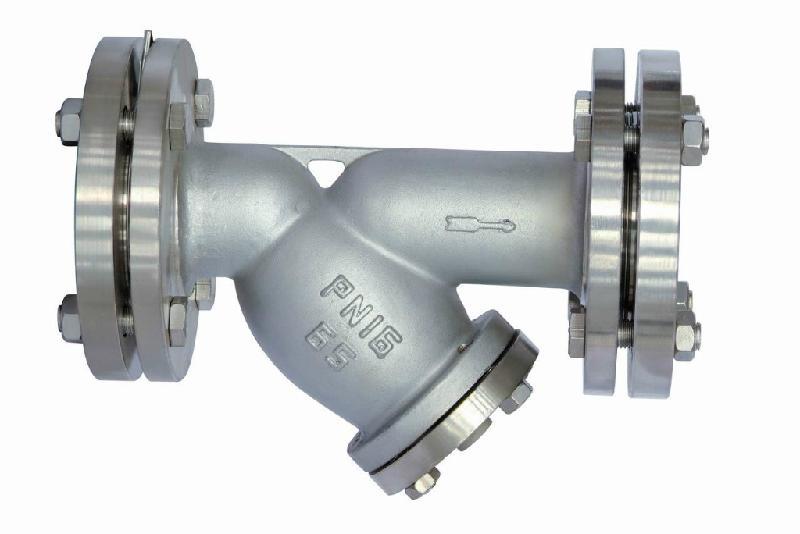
This deserves special mention. Y strainers are the preferred choice for steam applications. Basket strainers – and to some extent T strainers – can have issues with thermal cycling, leading to gasket leaks. Y strainers handle the high temperatures and pressure drops of steam systems reliably .
How to Choose – A Simple Rule
So how do you decide? It comes down to four key factors.
Factor 1: Pipeline size
If your pipeline is 2 inches (DN 50) or smaller, a Y strainer is usually the standard choice. If it’s 3 inches (DN 80) or larger, a T strainer is often more appropriate .
Factor 2: Debris load
If the fluid is relatively clean – like city water, natural gas, or steam – a Y strainer handles the job just fine. If the media has significant solids, rust, scale, or other contaminants, the T strainer’s larger chamber will save you from constant cleaning .
Factor 3: Installation space
If your pipe rack is tight and you don’t have room for a bulky strainer, go with the Y. If you have space and need high capacity, the T is worth the extra footprint.
Factor 4: Maintenance requirements
If you can afford frequent cleaning, a Y strainer works. If you want to minimize maintenance downtime, a T strainer’s larger capacity is a big advantage.
Common Mistakes That Cost You Money
Mistake #1 – Using a Y strainer in a dirty system. The small chamber fills up fast, causing pressure drop to spike. You’ll be cleaning it constantly – or worse, it will clog and starve your downstream equipment.
Mistake #2 – Overlooking installation space for a T strainer. It’s bulky. If you don’t leave enough clearance to pull the screen out, maintenance becomes a nightmare.
Mistake #3 – Choosing by price alone. A Y strainer is cheaper upfront. But if your system needs the capacity of a T, the constant maintenance and downtime will cost you far more in the long run.
Mistake #4 – Ignoring pressure drop. A clogged Y strainer can cause pressure drop to rise sharply. If you’re not monitoring it, you could damage pumps or reduce system performance.
Mistake #5 – Using the wrong strainer for steam. While Y strainers are standard for steam, some engineers mistakenly use basket or T designs. The thermal cycling can cause leaks and failures .
Conclusion
Y strainers and T strainers both do the same job – filtering debris from pipelines – but they’re designed for different conditions. The Y is compact, affordable, and works well in clean fluid systems and tight spaces. The T is larger, more expensive, but offers higher dirt-holding capacity and lower pressure drop in big lines.
The choice really comes down to three questions:
- How big is your pipe? (Under 2″ → Y; over 3″ → T)
- How dirty is your fluid? (Clean → Y; dirty → T)
- How much space do you have? (Tight → Y; ample → T)
Factor in your media, flow rate, and maintenance preferences, and you’ll make the right call.
Post time: Sep-04-2026